Shop With Amazon

Http://terrysthoughtsandthreads.blogspot.com is a participant in the Amazon Services LLC Associates Program, an affiliate advertising program designed to provide a means for sites to earn advertising fees by advertising and linking to Amazon.com
Showing posts with label Boston. Show all posts

Friday, May 3, 2013

Deal Killer, by Neal Sanders

Neal Sanders is an author whose mystery books not only pose a puzzle, but offer an insider's view of ordinary worlds not always known to all ordinary people. His earlier murder mysteries enticed readers to reflect on the many facets of running a gardening club, involving social/economic changes in small towns, and personal interactions between generations.

Deal Killer invites us into the executive boardrooms of competing industrial plants, introducing us to a host of characters ranging from 'woodchucks' (or 'go-fers' in other arenas) to CEOs (chief executive officers)and bank accountants, project managers, Boston Irish Mobsters to, to New Hampshire state troopers (in a different light than in his Hardington stories.) His settings range from the woods of New Hampshire to large chain hotels in the small city of Nashua, to the famous Boston Fanueil Hall Marketplace and to the back rooms of a bar in South Boston.

What is not different from his earlier works is his ability to build strong characters with deceptive ease, allowing his readers to understand each player's individual motivations and values. By using interactions and conversations between his people to show the power plays behind the scenes, the complexity of what may be seen by the uninvolved public as a simple transfer of ownership, and the stakes involved in personal investment of loyalty, commitment and dedication to an employer's goals and dreams, Sanders educates us and entertains us without distracting us from the hanging question of 'who dun-it' as the chapters unfold.

With a strong female protagonist cast in a mousy persona and secondary seat at the table, to the deceptively benign posture of the head of a corporation ... and in a beautiful blonde's predictable guile balanced by her focused intelligence and resourcefulness, Sanders quietly establishes the truth about not judging people by their outward appearances, their occupational identities, or their public facades.

After reading this story, it's unlikely that one would ever look again at a corporate buy-out story in a newspaper as "just business." The threads of this story are as seamlessly, purposely woven as the most obscure pattern in a story of old... a story that concludes with the right thing being accomplished by just the right person, for the right people.
Enhanced by Zemanta

Saturday, March 23, 2013

A Murder in the Garden Club by Neal Sanders

Neal Sanders is a local author who incorporates the art work of a local illustrator, Lynne Schulte, in his books. A Murder in the Garden Club is one such book.

Sanders writes of a small suburban town outside the City of Boston. During the boom of larger and larger homes taking over once-revered older homes, the town of Hardington is an example of the rising and falling of the American economy. In the eighties, McMansions of all styles were appearing on former farmland pastures, with little more than an acre to spare, placing oversized colonials shoulder to shoulder with Southwestern red-tiled roofs shadowed by tall European Tudors.  And when the economy slid downward, and tastes became less eclectic, those houses stayed on the buyer's market for long inactive months.

Still, in towns like Hardington, volunteer groups made up of a population of well-funded women with time to spare, who dedicated that time to beautification of their town's intersections and open spaces, continued to advocate for reasonable growth and attractive settings. One such group, the Hardington Garden Club, conducted monthly meetings where assigned tasks such as watering the highway exits' bouquets of blooms (often involving lugging heavy containers of water to such isolated sites) and shopping for, planting, weeding and deadheading those chosen areas were often at the top of the agenda.

When a prominent, retired school teacher and long-time member of the Garden Club is found dead at her home, an apparent accidental death presumably caused by her little dog Chipper, her quarrels with a contractor building another McMansion next door, and her irritation and outbursts of anger toward a cement manufacturing plant in town whose trucks are tearing up the roads and spilling noxious liquids on the roadside gardens, begin to raise speculation that this was not an accidental death.

Liz is her friend, and co-gardener, and wants to learn the truth of Sally's death. She begins reluctantly, and then enthusiastically, working with the recently-hired detective in town. John Flynn took early retirement from the City of Boston Police Department, and is finding his new job in Hardington quite different from the well-provisioned and connected resources available in Suffolk County (Boston.) Here in Hardington, with a small town Chief of Police whose name is the source of the town's own name, where murder doesn't happen more than one in a decade, if that often, things are done slowly, calmly, so as not to upset the citizens. His frustration with that is complicated further by his own marital stresses, and he begins to see Liz as more than just a helpful local volunteer.

Liz's own marriage is depicted as happier, but lonelier, as her husband is often on the road, in other states, saving companies which have been hit hard by the economy. Her own child is grown and gone, and she is left alone to care for her extensive gardens and larger-than-now-necessary home. Liz dedicates her time to helping John Flynn understand the social dynamics of the town.

Neal Sanders' characters come quickly to life in recognizable settings. He has more books that either follow or precede this one, and I look forward to reading those, too. And Lynne Schulte's artwork makes for delightful covers of Sanders' books. Click here to find more of Neal's books at Amazon, and click here to see more of Lynne's art:  www.lynneschulte.com
Enhanced by Zemanta

Sunday, July 8, 2012

Well, it's been quite a week!

US Navy 070704-N-8110K-009 The USS Wasp (LHD 1...
Click on photograph to enlarge and read the press. US  (Photo credit: Wikipedia)
I know, weeks don't typically end on Sunday, but this one needed a quiet day to finish up. Rick and I were concerned for all the folks in  Boston who had spent an entire day on the Esplanade along the Charles River waiting for the evening Fourth of July Pops concert and fireworks. We were at home ready to enjoy the festivities by way of Channel Four's television coverage, with the promise of uninterrupted fireworks at the end of the concert.

But while we were waiting, Rick enjoyed a medley of John Williams' music in honor of his birthday, and I went out on the screened porch to watch the fireflies enjoy the hot, humid air. They lit up the space around the birdfeeders, while lightning lit up the skies above. The thunder was a good ten seconds delayed after each flash, but when it rumbled, it rolled and continued for sometimes more than a minute.

The lightning never touched ground here in town, but it was definitely focused about ten to twelve miles south of us, given the length of time before the thunder. It was as beautiful as the fireworks would be later. But when the lightning was tracked by meteorologists to be moving toward Boston itself, the Massachusetts Emergency Management Team evacuated the oval park in front of the Hatch Shell - a first in the many years the concert has been held there. Spectators were encouraged to take immediate shelter, and the nearest to the crowd was within the Storrow Drive tunnel ... a damp, humid, oppressive site as compared to the open air concert they had been attending. The concert itself stopped to allow the musicians to seek shelter as well.

Half an hour later, the thunderstorm had passed through, and the crowd was allowed to return to the park. The concert resumed, the 1812 Overture sounded (it had been recorded the night before during the dress rehearsal, enjoyed by many who wouldn't be there on the Fourth) but when the crowd had reassembled, the Star Spangled Banner was played to lead into the fireworks display.

Our Chevy Traverse, Abby, injured by a dead fallen branch
No one was hurt at the Esplanade; the emergency crews were professional and pleased with the people's safe cooperation, and 'a good time was had by all.' Rick and I didn't discover until the next morning that within all that beautiful lightning and rolling thunder, a dead branch on a tree next to our driveway fell, hitting and denting the front of the roof and smashing the windshield of our Traverse (whom we refer to as 'Abby.' We'd called Rick's  pickup truck, while we still had it, 'Gibbs.' Abby was so named because she reminded us of funeral cars. Gibbs was just a logical choice to follow.)

We didn't see the dent until Rick went out to take photographs of the windshield. When the glass replacement worker came out, he said the insurance company would not like to replace the windshield and then fix the roof, because that would require another windshield replacement. He suggested we get the roof fixed as it would only eventually rust and leak, and so we arranged to have it taken care of by our friend Mark at his local auto repair shop. And, as we'd sold Gibbs last fall, we had to rent a vehicle for the 'week to ten days' period without Abby. We could choose between two: a silver Ford Focus, or a black Chevy Sonic. We took the Chevy, having lived once with a Ford (which is another story for another day.)  The Sonic looks like a miniature Traverse, and seems quite comfortable in the driveway. When I look out the window, it seems as though Abby has shrunk in the rain!

To see more quilts: Terry's Books and Quilts
The week ended well. I spent some time making two quilt tops, finished one with fleece and gingham, posted it at the webstore, and within three minutes it was sold! I had gone back to the site to check that it had posted what I'd just added ... something I've learned it's important to do, to make sure that the post was saved. Much to my surprise, it already said 'out of stock!' I went next to my email, and there was a notification from PayPal that it had indeed been sold to a friend who had bought a quilt earlier this summer at the site, and was watching for another that appealed to her ... I'm happy to know that she caught the posting right away and has another of my creations. Thanks, Jude!


Enhanced by Zemanta

Tuesday, June 12, 2012

Teaching Vol. I, Chapters 4 ,5, and 6

Are you looking for more summaries of the chapters of this book, Teaching: Education and Academics at the Turn of the Century?

Yesterday's blog previewed the first three. They were written during a difficult time in our lives ... all of our living parents were ill and needed our daily assistance. In 1999 my mother died, and in 2001 my dad died. Teaching full time was still challenging, though the all-nighters I spent with my parents that first year did allow me some quiet quality correcting papers time in the wee hours of the mornings.

When did I write the columns,  you ask? I wrote them in odd moments at home, on weekends between laundry and grading chores, and sometimes in bits and pieces of paper napkins in the teachers' room at school.

"Pendulum" was the second column written, and the only one that I needed outside research to support. I had always admired the Foucault pendulum at the Museum of Science in Boston. It made me stop and think: we are actually moving through space at an alarming pace; yet, that pace establishes the gravity that holds us on this planet. I wanted to represent the symbol of the pendulum accurately, so I emailed the museum's library staff, and asked whether they had something in writing about the pendulum. They did, and sent a large quantity of information, which I then shared with my science/math partner. When I went into the library to give them a copy of the magazine, I introduced myself to the librarian. She looked startled, and exclaimed "You are a woman!"  I agreed with her, and we shook hands. I gave her the magazine, open to the page that bore my article, and turned to leave. She thanked me for the magazine, apologized for her reaction, and we laughed together.

But you wanted a summary of this column, "Pendulum," and I shall oblige you. A teacher who has taught for more than fifteen years has witnessed the swing of the educational pendulum. Unlike the sundial which registers only the passing of hours, and seasons, the pendulum moves through time and space with a force of gravity. It's swing length is predictable, as it depends on the length of its tether. I comment on the extreme ends of the pendulum's swing as being the most difficult part of its passage. The education reform movement which stutters back to life every ten years or so has, at times, caused an abrupt about face in educational policy. An example of that would be the factory-like behavioral beginnings of education, shifting suddenly to the whole language whole child developmental approach, and then moving slowly along that centered path, building momentum again to suddenly reverse direction and head back with common core standards and mandatory one size fits all assessments. But, to make the analogy more complex, I had to factor in the earth's own rotation, and our ride through space.

"Learning in Circles" is the next article in the book. That gave me an opportunity to compare the depth of discussions resulting in Literature Circles, Paideia Seminars, and Socratic Circles. Each has its own origin, and each has its followers. I explain these differences by having teachers exchange questions and comments during a lunch period at school ... and I had fun writing the conversations and character descriptions. I enjoy using dialog to set scenes that feel familiar to the reader.

"The Rank Book" is another piece where I considered using dialogue, but instead I posed hypothetical questions to a hypothetical audience. If I could share just one sentence from this article with you, with the expectation that it would summarize the general tone and scope of the article, I would share this one: "...It would be easy to fall into the 'assign and assess' model, with the key elements, teaching and learning, minimized by the focus on designing elaborate rubrics for scoring and grading."  Well, it comes close, but reading the full article will give a much deeper understanding.

I will come back again tomorrow to summarize two more sections of this little book. It really is a piece of my teaching history, and it does capture all of the varying degrees of the pendulum's swing. If I've succeeded in whetting your appetite for this book, remember to go to the sidebar to click on the CreateSpace link and enter the numerical password.  The discount code will only work this week. Next week, we'll be on to another of my books (and with another discount code!)

And - here's a musical gift for you! http://www.youtube.com/watch?v=UWB1Sqsx1jo


Enhanced by Zemanta

Monday, April 2, 2012

Health Activist Writer's Month, Day 2: a Quote

For the month of April, I've renewed the discount at CreateSpace for Multiple Sclerosis an Enigma. To receive 35% off the regular price, go to this link:
and enter this discount code at the checkout:VXXURQMH


Choose a quote that inspires you (postively or negatively) and free-write about it.

"Our most basic common link is that we all inhabit this planet. We all breathe the same air. We all cherish our children's future. And we are all mortal." JFK


Common links ... breathing the same air ... cherishing children ... cherishing their future ... recognizing mortality. I had this quote on a large poster of John Fitzgerald Kennedy, and hung it on the corridor wall outside my classroom. When I retired, I found a friend in the building that shared my admiration of this president, and who would promise to use the poster well. 


Kennedy was our president at the end of the Happy Days of the 1950s. He inherited the worries of a conflicted world across a different ocean, the Pacific. Vietnam was still being viewed as just a conflict, a place for America to step in and advise struggling countries. The cold war between America and the former USSR was well established, and the enemy was communism (or, to the other side, capitalism.) 


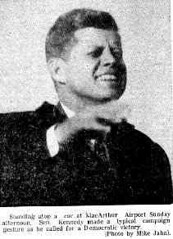
JFKIt was easy for JFK to impress me, as I was a ten year old when he was elected president. He was my president; I campaigned for him, carrying a homemade sign carefully lettered and spelled correctly, and I celebrated when he won the election despite the obvious handicaps ... being another from Boston ... being Catholic in a time when domination from across the seas was a threat to many, whether it might come from Russia or from Rome. 


JFK had young children. He had a beautiful wife. He had experience in the World War, and was a hero before he was president. His family came from the same city that I came from. He was from a family as large as my own. How could I not admire him?

When I was an adult, and he was long gone, the scandals were dragged out of the family closet. His beautiful wife went on to another marriage, in another country, and moved in even higher circles than she had as a young political wife. She became a symbol for all of the American women who lost husbands and fiances and brothers in the Vietnam "Conflict." But living as a symbol when the reason for your symbolism is removed was perhaps more than she would choose, and she moved on with her life. 

JFK knew that we were all mortal. He knew that we needed to protect the air that we all breathed, in an era when countries were competing with each other to have the most powerful and destructive tools of war. But he believed in a better use of scientific knowledge, and he authorized two vastly different programs: the race for the moon, and the Peace Corps. Because he did, man looked outward to the heavens and wondered about life beyond our atmosphere, and we began to look within our own sphere and recognize that things here needed more protection, more appreciation, and more collaboration.

It is not only because I was ten and easily inspired: JFK was the right man for our world at the time we all knew him. How sad that when he was gone, the appreciation was not sustained. We grew up, and are now older than he ever had a chance to be. In honor of his goals, and in respect for his memory, we all must do the best we can to protect this air that we all breathe, and to continue to cherish our children's future. 


Enhanced by Zemanta